Here in ZapSignWe have understood that KYC It is treated as what it truly needs to be in the operation: a process to identify the customer, verify that the data and documents belong to that person, assess risk, and decide whether the relationship can begin or continue. The acronym stands for Know Your Customer. When well-designed, KYC reduces fraud, improves compliance, and protects onboarding without turning each registration into a bureaucratic barrier.
Summary
- KYC combines identification, verification, risk classification, and monitoring.
- The workflow can be structured in six stages, from registration to continuous updating.
- The level of control should match the risk, without creating unnecessary friction.
- Onboarding time, abandonment time, and manual reviews help measure process quality.
What is KYC and what is it used for?
KYC is not just about asking for a name, CPF (Brazilian tax ID), and a photo of an ID. Collecting information is one thing; verifying its accuracy, confirming it belongs to the right person, and understanding the risks involved in the relationship are quite another. Central Bank Supervision Manual It describes identification as a process of collection, verification, and validation, the robustness of which must match the client's risk profile.
This reading also helps to distinguish KYC from a simple identity validationIdentity answers the question "who is this person?". KYC needs to move on to questions like "what is the risk of this relationship?", "who controls this company?" and "is there any reason for enhanced review?". In digital journeys, resources such as facial biometricsIn Brazil, background checks and proof of life are parts of the process, not the entire process.
| Stage | Operational question | Expected result |
|---|---|---|
| Pigtail | What data do I need to obtain? | Registration sufficient for the purpose. |
| Validation | Does the data belong to the customer? | Identity and documents confirmed. |
| Fact-checking | Are there PEPs, sanctions, or ultimate beneficiaries? | Additional risk context. |
| Classification | What is the level of exposure? | Low, medium, or high risk. |
| Decision | Can the relationship be approved? | Approval, rejection, or review. |
| Real Time | Has anything changed since I registered? | Updated data and risk information. |
How to complete KYC in 6 steps?
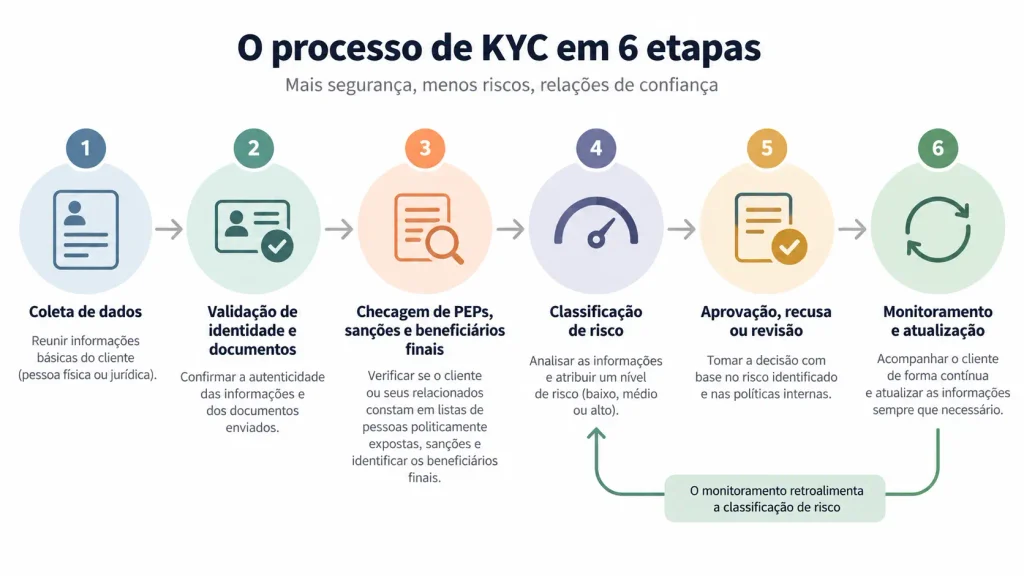
A good workflow doesn't start by choosing the tool with the most checks. It starts by defining which risks need to be controlled. This logic also appears in... KYC modularDifferent controls can be triggered depending on the context. Putting everyone on the most rigid journey can increase costs and turnover without producing a proportional gain in safety.
1. Collect only the necessary data.
Define which information is truly necessary to identify and qualify the client: name, CPF or CNPJ (Brazilian tax ID numbers), contact information, address, company information, and documents, according to the activity. For the subjects covered, the Law No. 9.613 / 1998 It requires customer identification, up-to-date registration, and the retention of certain records for at least five years. The design should stem from obligation and purpose, not from the desire to accumulate data.
2. Verify identity and documents.

Here, registration needs to move beyond mere declaration and become evidence. It's possible to combine document examination, registration consultation, liveness and KYCFacial recognition, comparison, and other signals. In a digital journey, this reduces the risk of someone presenting correct data that belongs to another person. More elaborate frauds, such as... synthetic identityThese studies show why validating isolated fields may be insufficient.
I often come back to a simple question: who's on the other side? When we launched an identity infrastructure at ZapSign, the logic was precisely to transform complex questions about identity into objective verifications, without requiring the user to understand all the technology behind it. For a product, this is a good benchmark: strong security needs to fit into the experience.

3. Check PEPs, sanctions and ultimate beneficiaries
When the relationship involves a legal entity or greater regulatory exposure, looking only at the formal representative leaves a portion of the risk hidden. COAF Resolution No. 41/2022 It involves collecting, verifying, validating, and updating registration data, identifying PEPs (Politically Exposed Persons) and end beneficiaries, and monitoring atypical or suspicious situations. The goal is to understand who is behind the relationship and what signs require additional attention.
4. Classify the risk

Transform the results of the due diligence into a decision rule. A low-risk client can follow a streamlined workflow; a case with document discrepancies, significant alterations, or signs of fraud can receive enhanced validation. Content about orange account e link between CPF (Brazilian taxpayer ID) and phone number These help to visualize this reasoning in layers. Safety is not about demanding the maximum from everyone, but rather demanding enough for each risk.
5. Approve, reject, or forward for review.
KYC needs to culminate in a clear operational decision. Define beforehand what is automatically approved, what is blocked, and what goes to human review. Without this rule, the company accumulates alerts that no one knows how to interpret. I have already highlighted in ZapSign projects the pursuit of greater security and governance without adding unnecessary friction for the user. This same choice applies here: a verification only makes sense when it changes a decision.
6. Monitor and update continuously.
KYC doesn't end when the customer joins. Registration information changes, representatives are replaced, risk profiles evolve, and unexpected behaviors can emerge after approval. Therefore, the policy should define update events and review frequency. An architecture of API identity verification This can help automate parts of that monitoring when the journey requires scaling.
Best practices for balancing safety and experience.
The most common mistake is treating security and conversion as opposing goals. They don't have to be. The right design uses proportionate checks and reserves heavier steps for those who truly require enhanced analysis. ZapSign itself allows you to combine different... validation methodswhile the discussion about API and LGPD This shows why purpose, transparency, and governance need to be integrated into the architecture from the very beginning.
It's also worth documenting approval criteria, reasons for rejection, rules for human review, and exception handling. This record reduces improvised decisions and makes the process auditable. When the operation includes electronic signatures, the security features They can connect identity verification, evidence gathering, and formalization within a single process.
What KPIs show if KYC is working?
I would track at least three metrics: average onboarding time, conversion or abandonment rate, and percentage of manual reviews. These show if the workflow is too fast, too rigid, or generating too much human work. Depending on the operation, add approval rate, reprocessing, and cost per completed verification. The goal is not to maximize a single metric. It's to balance risk, cost, and experience.
Check out these related articles as well:
- Understand how to structure the implementation of KYC in a company.
- See how liveness and KYC complement each other in identity validation.
- Discover ways to validate the signatory's identity in digital journeys.
A well-designed KYC transforms control into decision-making.
The best KYC (Know Your Customer) isn't the one that collects the most data or adds the most steps. It's the one that can prove identity, recognize risk signals, make a consistent decision, and continue monitoring the relationship without wasting the client's or team's time. When digital identity needs to be integrated into the product, learn about... ZapSign ID and assess where he can strengthen his KYC process.
Frequently Asked Questions (FAQ)
KYC stands for Know Your Customer. It's the process used to identify a person or company, verify the accuracy of the information provided, assess the risks associated with the relationship, and keep this information updated over time. The format varies depending on the industry, the risk involved, and applicable obligations.
There is no identical obligation for every company. The level of requirement depends on the activity, the sector, and the applicable regulations. Institutions and activities subject to specific anti-money laundering rules must comply with procedures defined by their respective regulators. Other companies may adopt KYC as a fraud and risk control measure.
Identity verification seeks to confirm whether a person is truly who they claim to be. KYC is broader: in addition to this confirmation, it can include registration qualification, beneficial owners, PEPs, risk classification, onboarding decisions, and ongoing monitoring. Therefore, identity verification is usually one of the steps in a KYC process.
This depends on the company's policy and applicable requirements. In general, the process may use registration data and official documents for identification, as well as corporate documents and information when a legal entity is involved. The key point is that the document should not simply be received: its consistency and its relevance to the client need to be verified.
The first step is to avoid applying the same level of verification to all users. Organize the workflow by risk, request only the necessary data, automate checks whenever possible, and send only cases that truly require human review. Then, monitor onboarding time, abandonment rates, reprocessing, and manual reviews to identify where the friction points are.

Getúlio Santos is the CEO of ZapSign, a lawyer, technology enthusiast, and entrepreneur.