O KYC process In e-commerce involving installment payments, it's essential to confirm the buyer's identity before assuming any financial risk. KYC for e-commerce It organizes identification, validation, and decision-making, while identity verification transforms declared data into sufficient evidence to support that that identity exists and belongs to the person present in the journey.
In our own credit system or BNPL (Brazilian National Credit System), the goal is not to create a cumbersome customer database. It's to reduce fraud without impacting approval rates, conversion rates, and checkout speed.
The starting point is simple: the greater the consequence of a wrong approval, the greater the trust required. A small purchase, with consistent registration and a regular history, can proceed with silent checks. However, a first purchase of high value, with registration discrepancies or a risky phone number, deserves an additional layer of scrutiny before credit is granted.
Summary
- KYC in e-commerce with payment terms should be calibrated based on the risk of the purchase and the identity verification.
- CPF (Brazilian taxpayer ID), phone number, and registration consistency can form the first layer of verification.
- Documents, selfies, and biometrics work better as a stepping stone than as a universal barrier.
- The policy needs to measure fraud and conversion simultaneously.
How to structure KYC for e-commerce by risk at checkout?

The first mistake is treating every installment purchase as if it carries the same risk. It doesn't. A well-designed rule begins by identifying the moment when the company truly assumes exposure: account creation, request for a credit limit increase, first installment purchase, phone number change, address change, or attempt to use a payment method different from the historical one.
This logic is consistent with risk-based approach As advocated by the FATF: the quality of the process depends not only on collecting data, but on understanding what information is verified and what evidence needs to be retained. For a decision-maker, this changes the question. Instead of "how many KYC steps will we have?", the question becomes "what risk does each step reduce?".
1. Collect the minimum amount of data and validate relationships between the data.
Name, CPF (Brazilian tax identification number), and phone number may be sufficient to initiate analysis in many journeys, but valid data does not guarantee identity. A CPF can exist and a phone number can be active without belonging to the same person. Therefore, it makes sense to cross-reference attributes and verify consistency, as in the flow of... CPF and phone numberThe same reasoning applies to signs of YES swap or to number verification when the telephone line participates in the authentication.
In the ZapSign ID, I returned to a question that I consider fundamental for any digital product: who is on the other side? The idea of transforming identity questions, such as the link between CPF (Brazilian tax ID) and phone number, recent SIM card change, or correspondence between selfie and document, into objective verifications shows why KYC (Know Your Customer) works best when each query leads to a concrete decision.
Documents and selfies should be a step-up, not a ritual.
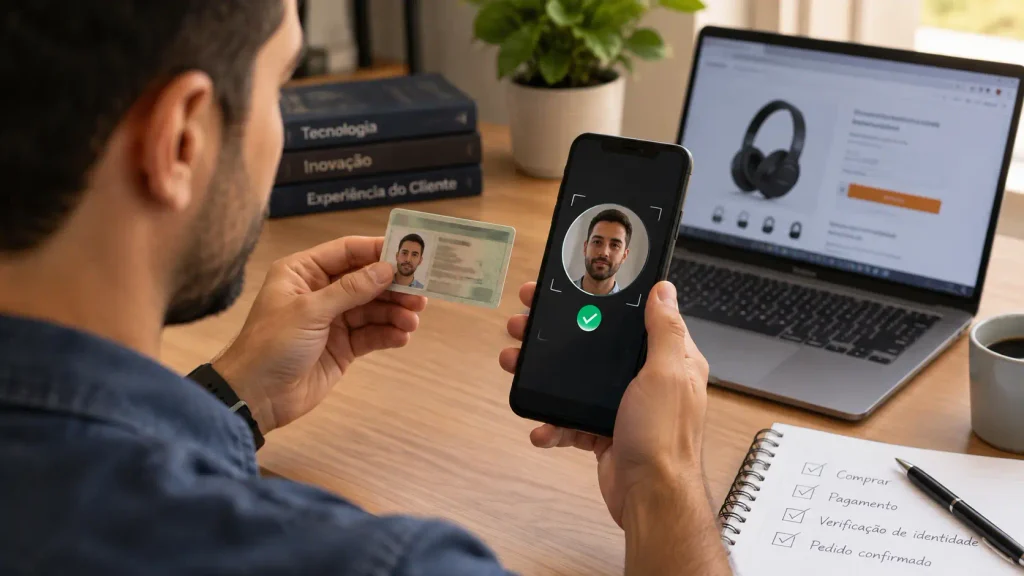
Requiring ID and a selfie from every buyer might seem like the safest option, but it can also increase abandonment, costs, and unnecessary false positives. The best scenario is a gradual approach.
Consistent registrations proceed with low friction; discrepancies, high-value purchases, first significant transaction, or signs of fraud receive a step-up. At this point, selfie with document, facial biometrics e liveness no KYC They start answering specific questions, instead of just existing to "toughen up" the checkout process.

O identity proofing model GOV.UK clearly demonstrates this progression: it's possible to gather evidence, validate its authenticity, verify the identity history, assess fraud risk, and confirm that the identity belongs to the applicant, increasing trust throughout the process. In e-commerce, the practical consequence is clear: not every purchase requires the same level of proof.
| Situation | Suggested answer | Objective |
|---|---|---|
| Consistent and low-risk registration | Automatic approval | Preserve conversion |
| Moderate divergence | Document or selfie as a step-up | Increase confidence |
| Strong indication of fraud. | Review or block | Contain loss |
2. Transform the checks into operational decisions.
Verification without decision rules only accumulates signals. The checkout process needs to know what to approve, what to send for review, and what to block. A API for KYC It helps when it returns results that can be incorporated into the risk engine, while the concept of KYC modular It allows you to add new layers without rebuilding the entire journey.
I have a clear preference for security that protects without getting in the way. When we speak publicly about using network signals to combat identity fraudThe benefit lay precisely in reinforcing trust without creating a new, visible step for every user. In installment plans and BNPL (Brazilian National Loan System), this principle is valuable: increase friction only when the risk justifies it.
Check out these related articles as well:
- Understand how to recognize signs of synthetic identity fraud.
- See how to adjust checks according to the risk level.
- Learn how to automate registration validations using an API.
Monitoring and KPIs show whether the protection is properly calibrated.
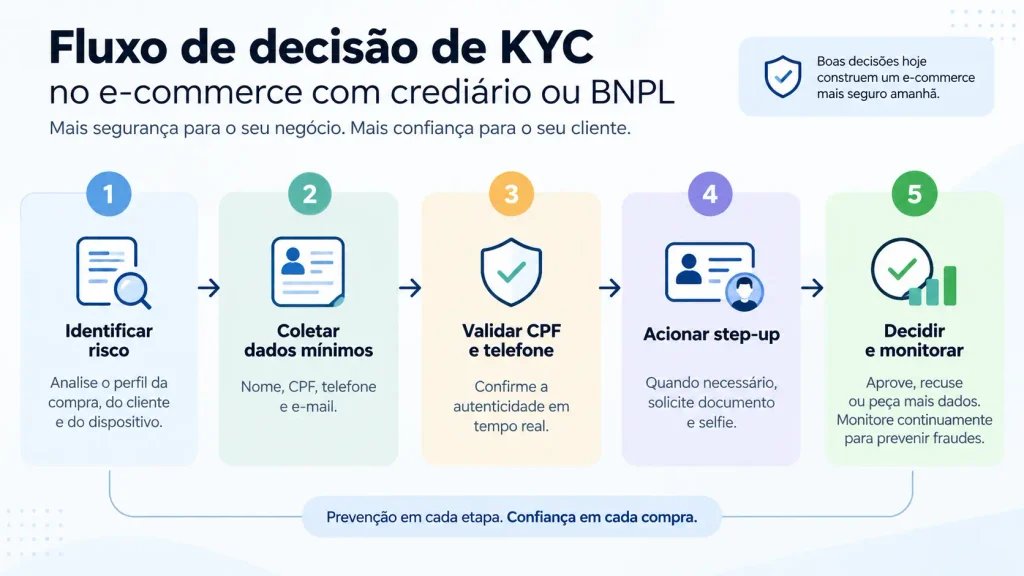
KYC doesn't end with approval. After the purchase, it's worth observing changes in registration information, repeated attempts, phone number changes, chargebacks, confirmed fraud, and unusual usage patterns. In a self-service financing operation, an account that changes contact information before new purchases may warrant reassessment. In BNPL (Brazilian Banking Network), multiple transactions in close proximity may justify a new risk assessment decision.
The market volume reinforces the need for calibration. According to the CFPB surveyOf the consumers surveyed, 21,2% used BNPL in 2022, and 63% of users had simultaneous loans at some point during the year. The lesson for the product is not to copy a policy from another market, but to recognize that quick installment payments require controls that keep pace with scale and recurrence.
| KPI | What it reveals |
|---|---|
| Approval rate | If the ruler is releasing legitimate customers |
| Checkout conversion | How much friction does verification add? |
| Verification time | Impact of analysis on experience |
| Fraud and chargebacks | Financial effectiveness of controls |
| False positive | Legitimate customers affected by the rule |
These indicators need to be interpreted together. Eliminating fraud at the cost of losing good customers isn't necessarily success. The same applies to maximizing conversion while accepting increasing losses. The design should be revised as behavior, product, ticket size, fraud, and experience change.
A good identity policy protects credit without hindering purchases.
Credit sales and BNPL (Brazilian National Credit System) require speed, but speed without reliable identity transfers the problem to fraud, collections, and customer service. The best design uses minimal data, validates relationships between attributes, adds documents and selfies only when necessary, makes decisions with clear rules, and continues to monitor risk after approval.
If your product needs to be placed KYC for e-commerce within the checkout process with proportional verifications, it's worth getting to know the ZapSign ID.
Frequently Asked Questions (FAQ)
KYC for e-commerce is the set of checks used to identify the buyer, validate that the data belongs to that person, assess risk signals, and decide whether a purchase or credit granting can proceed. In installment payment or BNPL (Brazilian National Credit System) transactions, the level of verification should match the risk of the operation.
Not necessarily. Documents and selfies make more sense when there are signs that justify greater trust, such as discrepancies in registration information, a first high-value transaction, or unusual behavior. Applying the same requirement to everyone may increase abandonment and costs without generating a proportional gain in security.
An initial workflow might involve using name, CPF (Brazilian tax ID), phone number, and registration consistency, provided the data collection is appropriate for the purpose. As the risk increases, other evidence can be included, such as documents, selfies, biometrics, proof of life, and signals associated with the phone or account behavior.
The best strategy is to combine silent checks with step-up checks. Low-risk registrations go through a short process; cases with discrepancies receive additional checks. Then, the company compares fraud, approval, conversion, verification time, and false positives to adjust the benchmark based on real results.
The main indicators are approval rate, checkout conversion, verification time, confirmed fraud, chargebacks, and false positives. Depending on the operation, it's also worth monitoring manual review, abandonment by stage, and cost per verification. Analyzing them together avoids optimizing security at the expense of legitimate customers.

Getúlio Santos is the CEO of ZapSign, a lawyer, technology enthusiast, and entrepreneur.