In a flow of identity validationConsent should function as a free, informed, and unequivocal expression of will for a specific purpose, and not as a bureaucratic screen placed before consultation. A good implementation of API in LGPD It informs what will be processed, for what purpose, with whom the data will circulate, and what decision depends on that validation; it records the authorization before the API call and maintains sufficient evidence for auditing. The challenge is to do this without turning data protection into account abandonment.
Summary
- Consent must enter the flow before the call that initiates the processing based on that authorization.
- Purpose, data processed, responsible agent, and option to opt out must be presented in an easily understandable way.
- The system must record the consent cycle, from request to granting, refusal, or withdrawal.
- Consent rate, abandonment rate, latency, and error rates help identify bottlenecks between compliance and conversion.
How to implement an API in accordance with the LGPD (Brazilian General Data Protection Law) without hindering identity validation?
The most common mistake is thinking of consent as a separate legal step from the product. When this happens, the legal department creates a lengthy text, the product department inserts a checkbox, and the technology department only verifies if the field was marked as true. The flow is formally "complete," but operationally weak. In a identity validationTherefore, consent needs to be treated as a business event: there is a purpose, an action by the data subject, a version of the notice, and a technical consequence.
After spending a few days in Estonia observing digital services and discussing innovation, I returned with a question that applies very well here: How can you reduce friction without sacrificing trust? For me, this is a better measure than simply counting how many screens were removed from onboarding. Poorly explained consent may be quick, but it creates risk. Overly legalistic consent may be defensible on paper, but it destroys conversion. A good product solves both problems at the same time.
1. State the purpose and details before the call.

The user needs to understand the operation before authorizing it. If the process involves checking documents, phone numbers, biometrics, or other signals to confirm identity, the interface should explain the purpose in language consistent with that decision. It is not necessary to expose the architecture of the... ZapSign API Or turn the screen into a privacy policy. It's necessary to answer what the user reasonably wants to know before continuing.
This concern becomes even more important when biometrics are involved. handling of sensitive data requires special attention, and flows that involve facial biometrics ou facial recognition They shouldn't hide this reality behind vague expressions like "proceed with the verification." Clarity reduces doubt, support, and disputes. It's a compliance decision that also improves the product.
2. Capture an affirmative action and record the evidence.
Consent should not be inferred simply because the user has moved to a different screen. ICO explains that consent It requires genuine choice, specific expression of intent, and affirmative action, as well as documentation capable of demonstrating it. In a product context, this points to a clear opt-in, without a pre-checked box and without confusing the authorization with other terms that address different purposes.
The record needs to be useful if someone asks months later: “what exactly did this person authorize?”. A consistent trail can associate user identifier, date and time, notification version, purpose, status, and origin of the action. The logic speaks directly to a strategy of digital traceabilitySimply storing a boolean value like “consent=true” is too simplistic for a journey that might need to be rebuilt.

| Stage | What to record | Risk avoided |
|---|---|---|
| Request | Purpose, data involved, and version of the notice. | Generic or ambiguous authorization |
| Decision | Acceptance, rejection, date, time, and context | Lack of evidence regarding the demonstration. |
| Chamada | Authorization identifier linked to the request. | Consultation without a traceable operational basis. |
| Post-flow | Status, revocation, failure, and possible new request. | Use of consent that is no longer valid. |
3. Only then send the authorization to the API.
Integration should prevent requests when the required authorization does not yet exist. This order seems obvious, but it often breaks down when front-end and back-end evolve at different paces. The interface displays the consent, while the service is already sending requests in the background. A API integration You need to consider consent as a verifiable precondition, not as UX decoration.
I've been emphasizing a distinction that applies to the entire digital transformation: digitizing parts isn't enough when the pieces don't communicate. The same applies here. The screen might be correct and the API might be correct in isolation, but the system remains flawed if authorization doesn't travel along with the workflow. True compliance emerges from the connection between product, legal aspects, and technology. That's when governance stops being just a document and starts controlling the behavior of the system.
How do we handle refusals, revocations, and failures without creating dead ends?
If consent is a choice, then refusal must be genuine. This doesn't mean that every service has to continue as is without the necessary processing. It means explaining the consequence clearly: without that authorization, a certain validation cannot occur, and there may be an alternative path, manual review, or another legal basis applicable to the specific case. ANPD informs that the data subject You can revoke your consent at any time, and the procedure should be made easy.
The system also needs to differentiate between refusal and technical error. If the user does not authorize, we have a decision. If they authorize and the API returns a timeout, we have an operational failure. If the selfie doesn't pass... liveness and KYCHowever, we have another condition. Mixing everything together under the heading "it was not possible to continue" undermines the diagnosis and increases abandonment. The product must present distinct messages; the technology must generate distinct statuses; and legal authorities need to know which states actually authorize treatment.
Consent states prevent improvised decisions.
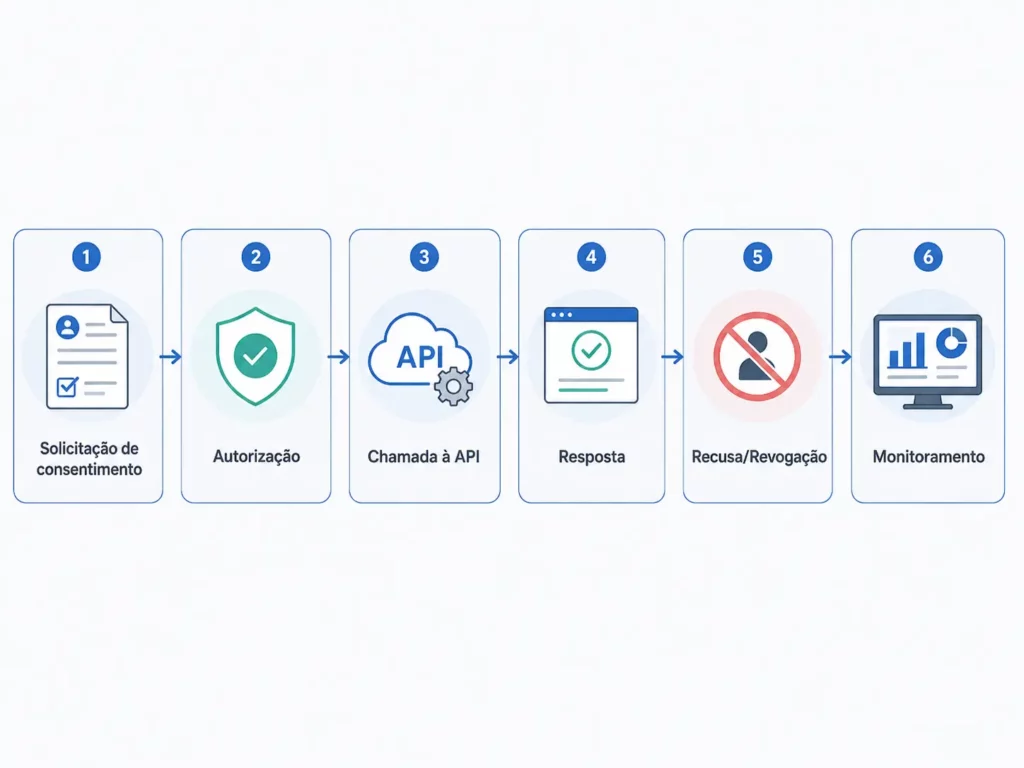
A mature implementation works with states, not just "yes" or "no." Pending requests, consent granted, refused, withdrawn, expired, or replaced by a new version may require different responses from the system. This model simplifies auditing and prevents an old authorization from being reused for a new purpose. It also combines with features of... integration between systemsBecause each component can react to the same state without reinventing the rule.
What KPIs show if consent has become a bottleneck?
Well-implemented consent isn't consent that no one sees. It's consent that people understand and can conclude without unnecessary doubt. To measure this, I would look for four signs: consent rate, abandonment rate, latency rate, and errorsThey don't answer everything, but they show where to investigate. A drop in consent may indicate a poor explanation; abandonment may point to excessive steps; latency may reveal an integration problem; errors help separate UX from infrastructure.
- Consent rate: The ratio between requests displayed and authorizations granted.
- Abandonment: percentage of users who abandon the journey at or immediately after this stage.
- Latency: The time between acceptance, the API call, and the response required to proceed.
- Errors: Technical glitches, invalid responses, and interruptions that prevent validation from being completed.
These indicators should be read together. A drop in abandonment accompanied by an increase in errors, for example, does not represent real improvement. Similarly, near-universal authorization may warrant review if the language is too vague. automation features and the methods of signatory identification They make more sense when the company measures both security and fluidity.
Check out these related articles as well:
- LGPD (Brazilian General Data Protection Law) and digital signatures can be structured within the same consent and evidence journey.
- OneClick demonstrates how electronic acceptance and traceability can coexist in a simple experience.
- Financial services require integration between onboarding, identity, formalization, and compliance controls.
Good consent reduces risk without turning compliance into an obstacle.
The best architecture doesn't treat LGPD (Brazilian General Data Protection Law) as a barrier placed after the product is ready. It incorporates purpose, choice, registration, revocation, and monitoring into the flow itself. This allows the... API in LGPD It should be implemented with a simple logic: inform beforehand, obtain an unequivocal action, record the evidence, authorize the call, handle refusals, and track performance. To combine identity validation with a traceable signature journey, learn more about... ZapSign ID.
Frequently Asked Questions (FAQ)
No. The LGPD (Brazilian General Data Protection Law) provides for different legal bases for data processing, and the classification depends on the purpose, the type of data, and the context of the operation. When the flow is based on consent, the authorization must be specific, informed, and demonstrable. The mistake is treating consent as a universal requirement or, at the opposite extreme, ignoring it when it underpins the processing.
Technically it's possible, but this isolated record is weak for governance. It's better to associate the status with the purpose, the notification version, the moment of the request, and the journey identifier. This way, the company can reconstruct the context of the authorization, verify if it remains valid, and distinguish between consent granted, refused, withdrawn, or replaced.
The best leverage is usually clarity, not concealment. Explain the purpose, the necessary data, and the consequence of the choice in a few sentences; separate different authorizations and avoid lengthy legal texts within the main step. Then, monitor abandonment, screen time, and consent rate to discover if the friction stems from the language, layout, or technical flaws.
The system must record the withdrawal, stop future uses that depend on that authorization, and forward the case according to applicable legal and retention rules. The revocation should not remain solely in a service request disconnected from the systems. Ideally, the new status should propagate to the components that control processing, integrations, and decisions.
Monitor at least the consent rate, abandonment rate, validation latency, and errors per step. The value lies in the overall analysis: high consent with ambiguous language is not a success, just as low latency with many failures is not either. In an LGPD API implementation, security, comprehension, and conversion need to evolve as parts of the same system.

Getúlio Santos is the CEO of ZapSign, a lawyer, technology enthusiast, and entrepreneur.