On a journey of identity validation, account takeover (ATO) is the unauthorized access and control of a legitimate account. The risk doesn't end when someone guesses the password: the attacker can change credentials, alter registration data, maintain an active session, and perform actions that appear to come from the user themselves. For the company, a well-calibrated defense reduces fraud, financial losses, recovery calls, and operational friction without turning every interaction into proof of identity.
The most common mistake is treating ATO (Authorization to Transmit) as a problem exclusive to the login screen. A better strategy distributes controls throughout the journey, from initial authentication to password recovery and high-impact transactions. This brings security closer to a more holistic logic. anti-fraud analysisObserve the context, match the signals, and increase the requirement only when the risk truly rises.
Summary
- ATO needs to be treated as a work-related risk, not just a password error.
- MFA, phishing-resistant authentication, and attempt limitation strengthen login.
- Password resets, device changes, and registration updates require their own separate controls.
- Step-up verification and session monitoring help prevent fraud after login.
- False positives should also be included in KPIs, because excessive security translates into cost and abandonment.
How to protect your login against account takeover?
Passwords remain a useful barrier, but they shouldn't solely bear the responsibility of proving who is logging in. Leaks, credential reuse, and phishing make this model fragile. FTC He explains that the second factor prevents username and password alone from being sufficient for access, and notes that authenticator apps or security keys can offer advantages over codes sent via SMS.
MFA needs to reduce risk without turning it into a ritual.
Adding steps for everyone, at every login, seems like security, but it can lead to abandonment and unnecessary support. I prefer a different logic: strong protection with the least friction commensurate with the risk. This vision is also reflected in the work we've been doing at ZapSign to strengthen identity validation without penalizing the experience of those acting legitimately. Good security needs to block the fraudster without teaching the customer to hate the product.
In other words, it's worth combining. best practices against fraudLimitation of attempts, device reputation, location signals, access speed, and account history. For higher-risk contexts, facial recognition Other factors may also act as reinforcements. The goal is not to stack barriers, but to make the system distinguish a routine login from an attempt that deviates from the norm.
When does phishing-resistant authentication make a difference?
If an attacker manages to trick a user into handing over their password and code on a fake page, some of the benefit of traditional MFA disappears. British NCSC It explains that credential stuffing exploits leaked and reused credentials and shows how FIDO2 uses unique credentials per service, with stronger anti-phishing properties. For administrative, financial, or high-transaction-power accounts, this difference deserves priority.
Password recovery and change cannot be a shortcut for fraudsters.

A highly secure login loses value if account recovery is too easy. Password resets, email changes, phone number changes, and registering a new device are events that should automatically increase the risk. The very... authentication with OTP This shows why an isolated code does not prove civil identity: it proves access to a channel, and that channel may also have been compromised.

O Institutional Security Office It is recommended that the method used for password recovery should not be the same as the one used for the second factor. The operational consequence is clear: if email recovers the password and also confirms the login, compromising the email can breach two barriers at once. Separating channels and requiring re-authentication reduces this risk.
From the beginning of ZapSign, I have argued that security and simplicity are not opposing goals. This also applies to account recovery: the flow needs to be understandable for the legitimate user, but not so predictable as to become a backdoor for the attacker. In higher-risk journeys, liveness and KYC They can serve as additional layers of verification.
Sensitive transactions require a new risk assessment.
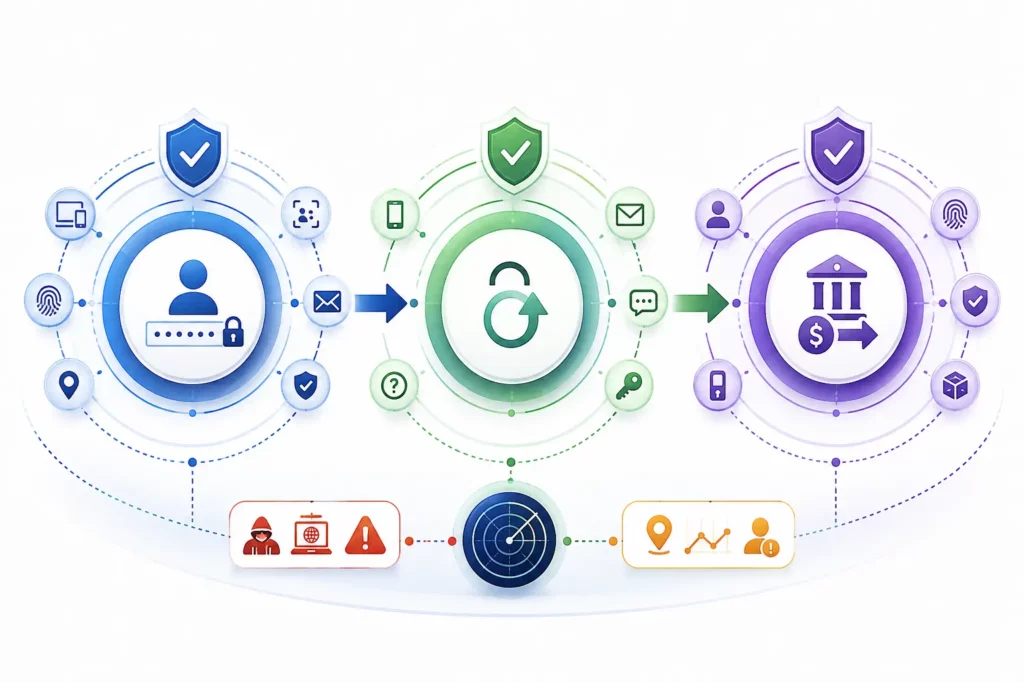
Passing through the login process shouldn't grant unrestricted authorization for everything that comes after. Changing bank accounts, altering recovery data, signing a relevant contract, or executing a financial transaction changes exposure. In these situations, re-authentication and step-up make sense: the system requests additional evidence because the consequence of the action is greater. This same principle appears in workflows of... signatory validation, in which the level of verification may vary depending on the risk.
Signs that indicate a need to step up.
| Signal | Possible answer | Expected impact |
|---|---|---|
| New device | Re-authenticate and confirm ownership | Reduces the use of stolen credentials. |
| Recent password reset | Restrict sensitive action temporarily. | Prevents fraud immediately after recovery. |
| Change of phone number or email address. | Validate old channel or identity | It makes it difficult to take full account. |
| Non-standard transaction | Apply step-up | It concentrates friction where the risk has grown. |
| Session with anomalous behavior | Revoke session and request new login. | Limits session hijacking |
This is also where session monitoring ceases to be a technical detail. Abrupt context switches, sequential actions incompatible with the history, or attempts to modify various recovery factors deserve correlation. An architecture of KYC via API It can help organize decisions and evidence, while methods such as advanced liveness They come in when proof of attendance needs to be reinforced.
What KPIs show whether the protection is working?
Counting account blocks isn't enough. A policy that blocks fraud while also preventing legitimate customers from accessing their accounts is poorly calibrated. I would track at least suspicious attempts, anomalous resets, blocked accounts, step-up rate, false positives, abandonment during authentication, and confirmed fraud after login. A combined analysis shows whether the company is shifting the problem, resolving it, or simply increasing support costs.
Quality control becomes apparent when safety, operation, and experience improve together. Safety e identity validation They help visualize how different methods can be combined depending on the context, without assuming that a single step works for the entire process.
Check out these related articles as well:
- Understand what evidence helps to assess the reliability of an electronic signature platform.
- Learn about the main risks of fraud in facial biometrics and how to reduce exposure.
- See how proof of life reinforces identity validation in digital journeys.
Layered defense reduces fraud without turning security into an obstacle.
A single technology cannot solve the problem. Strong login, secure recovery, risk context, session monitoring, and step-up need to function as parts of the same decision. When these controls are designed together, the legal department gains more traceability, operations reduce rework, and the product avoids imposing the same friction on everyone.
The best program against account takeover It's the one that protects the account throughout the entire journey and can explain why an action was approved, reinforced, or blocked. If your operation needs to add identity validation to sensitive moments without disrupting the digital experience, learn more about it. ZapSign ID.
Frequently Asked Questions (FAQ)
Account takeover is the unauthorized takeover of a legitimate account. The attacker can obtain credentials, exploit password recovery, hijack a session, or manipulate authentication factors. After gaining access, they attempt to act as the real user, altering data, executing transactions, or maintaining persistence in the account. Therefore, defenses need to cover more than just login.
No. MFA increases account resilience, but the outcome depends on the chosen factor and the rest of the journey. Phishing, compromised recovery channels, session hijacking, and social engineering can still create attack paths. The most consistent design combines MFA with attempt limitation, risk analysis, re-authentication, and critical change monitoring.
Step-up makes more sense when the risk of the action outweighs the risk of a regular login. Examples include changing your phone number, email address, registering a new device, financial transactions, changes to bank details, or high-impact signatures. Instead of always requiring an extra barrier, the system increases the requirement when context, behavior, or consequence justify the additional verification.
Because account recovery can bypass strong login controls. If an attacker compromises the email or phone used for the reset, they can change the password and take over the account even without knowing the original credentials. Separating channels, logging changes, and requiring additional validations in high-risk situations reduces the chance of the reset becoming a backdoor.
It's important to monitor suspicious login attempts, anomalous resets, account blocks, step-up usage, session revocations, false positives, abandonment during authentication, and confirmed fraud after login. No single metric tells the whole story. The goal is to simultaneously measure fraud reduction, operational impact, and friction created for legitimate users.

Getúlio Santos is the CEO of ZapSign, a lawyer, technology enthusiast, and entrepreneur.